Workshop Ecotic 2026
"Detourned Machines: Creative Misuses of Robots and Virtual Agents"
Wednesday April 22nd 2026 @ The University of Tokyo (Hongo Campus) & online
After Ecotic 1 in 2018 and Ecotic 2 in 2020, and Ecotic 3 in 2022 and Ecotic 4 in 2024 we are pleased to announce that Ecotic 5 will take place on April 22nd 2026 at the University of Tokyo, Hongo Campus.
In person in Tokyo, Japan, and online for the rest of the world. Save the date and register, the "in person" attendance is limited to 50 people.
We are pleased to invite you to the fith edition of the workshop Ecotic, a unique workshop on philosophy and technology where we discuss about the ecotic challenges of artistic, religious and societal stakes of autonomous robotics with a panel of experts, and where we try to answer some thought provoking questions.
This year the topic of the workshop is "Detourned Machines: Creative Misuses of Robots and Virtual Agents"
To attend the event, it is mandatory to register in advance as seats are limited to 50.
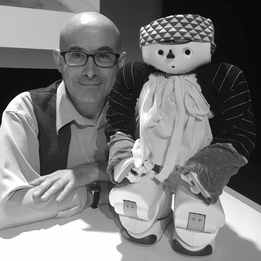 |
Dominique Lestel (ENS, Paris) is a French philosopher with in the Department of Philosophy of the Ecole normale supérieure of Paris (ENS) where he teaches contemporary philosophy and works mainly on the philosophy of human/non-human shared life. He has been a research engineer in Bull Artificial Intelligence Lab (1984-1986) and got a Ph.D. of the EHESS in 1986. He introduced cognitive sciences at ENS in 1994, with logician Giuseppe Longo and physicist Jean-Pierre Nadal and he has been a founding member of the Department of Cognitive Sciences of ENS until 2012. He has got research positions at University of California, MIT, Boston University, Université de Montréal, Macquarie University and has been a Visiting Professor at the School of the Art Institute of Chicago, at Tokyo University of Foreign Language and at Keio University. In 2013-2014, he was a visiting scientist at the University of Tokyo, in the Japanese-French Laboratory of Informatics with a grant by the French National Center of Scientific Research (CNRS) to work on the philosophy of existential robotics. He has published many books including “Eat that Book. A Carnivore’s Manifesto”, 2016, Columbia University Press. In 2014, the Oxford journal “Angelaki: Journal of the Theoretical Humanities” has published a special issue on his work. In 2017 in was awarded long-term JSPS Fellowship to work with Gentiane Venture at TUAT, Japan. In 2018 he was a Berggruen Fellow writing about “existential machines” and the interaction of humans and machines on an emotional level at the Center for Advanced Study in the Behavioral Sciences at Stanford University, USA.
|
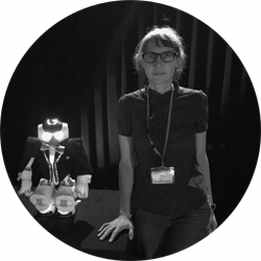 |
Gentiane Venture (UT, Tokyo) is a French Roboticist working in academia in Tokyo for more than 20 years. She is a professor with the department of Mechnical Engineering at the University of Tokyo. She obtained her MSc and PhD from Ecole Centrale/University of Nantes in 2000 and 2003 respectively. She worked at CEA, France in 2004 and for 6 years at the University of Tokyo, Japan. In 2009 she started with Tokyo University of Agriculture and Technology where she has established an international research group working on human science and robotics. In 2022 she moved her lab at the University of Tokyo. With her group she conducts theoretical and applied research on motion dynamics, robot control and non-verbal communication to study the meaning of living with robots. Her work is highly interdisciplinary, collaborating with therapists, psychologists, neuroscientists, sociologists, philosophers, ergonomists, artists and designers. She is was made knight of the National Order of Merit in 2022.
|
contact us: ecoticonline@gmail.com
 a workshop organized with the support of Kawada Technologies